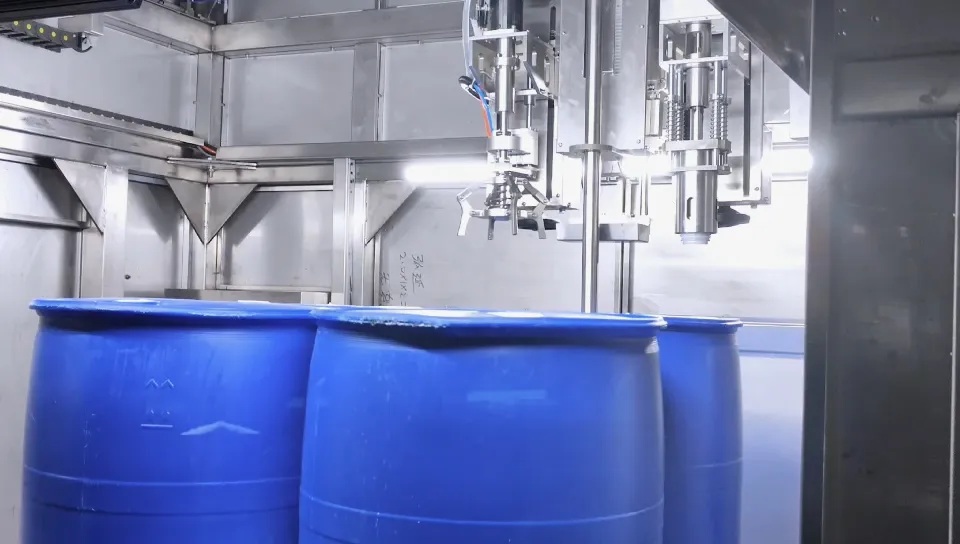
Stand beside a pallet of four empty steel drums at seven in the morning and ask how long it will be before they leave full, sealed and labelled. In many plants the honest answer depends on who is on shift. Mechanised drum filling exists to make that answer the same every day, and the easiest way to see what it changes is to follow a single 200-litre drum through each step and notice where the hand work used to be.
The Empty Drum Arrives
Our drum comes in on a pallet with three neighbours, bungs loosely fitted, a little dust on the lid. On a manual line an operator would wrestle the pallet under a hose and eyeball the position. On a filling station the pallet rolls onto a conveyor or is set down by forklift on a platform that is itself a weighing scale. Guides square it up. Nobody stands between the drums, which matters more than it sounds once flammable or corrosive product is flowing.
Finding the Bung Hole
The large bung has to sit under the nozzle. Semi-automatic stations leave this to the operator, who swings a counterbalanced arm across and lines the lance up by eye, a job of a few seconds with no lifting. Fully automatic stations use a camera or sensor to locate the opening and move the lance to it. Either way the drum stays put and the filling head travels, which is the reverse of the old habit of nudging a heavy container with a boot.
Earthing Before a Drop Flows
If the product is a solvent, the next action is invisible but vital. Liquid moving through a pipe builds static charge, and a spark at an open bung can ignite vapour. An earthing clamp is attached to the drum and the control system checks the connection before it will permit the valve to open. Stations built for such duty use explosion-protected components and draw vapour away through an extraction hood around the lance. On a hand line these steps rely on memory.
The Lance Goes Down
Now the lance descends, often right to the base of the drum. Filling from below the surface, and rising as the level rises, keeps the stream from splashing, which limits foam and static alike. Thin, non-foaming liquids can be filled from the top instead. The choice is part of specifying drum and IBC filling stations, and it should be made with the actual product in hand, since a detergent concentrate and a base oil behave nothing alike in the same container.
Fast First, Then Slow
The scale reads the empty drum and zeroes it, so the drum’s own weight is ignored. The valve opens wide and product pours in at full rate. Near the target the controller throttles to a trickle, the dribble feed, and closes the valve fractionally early to allow for liquid still in mid-air. This two-speed approach is why a weight-based filler can be both quick and accurate. An operator with a hose and a floor scale has to choose one or the other.
Lifting Out Without a Mess
When the target weight is reached the lance rises, pausing so the last drops fall inside the drum. A drip tray swings under the nozzle before it moves away. That small cup is the difference between a clean drum top and a sticky ring that attracts dirt, ruins labels and, with some chemicals, eats paint. Over a year the product saved from the floor is modest; the cleaning time and the slip hazards avoided are not.
Closing the Bung
Our drum now holds its 200 litres and needs sealing. A bung is threaded in and tightened to a set torque, then a cap seal is crimped over it as tamper evidence. On simpler stations the operator does this with a powered tool hung from a balancer; on automatic lines a head does it unattended. The point of controlled torque is consistency. Under-tightened bungs weep in transit and over-tightened ones damage the gasket, and both look fine on the day.
A Record for Every Drum
Before the drum leaves the scale, the controller stores what happened: product, batch, target, actual weight, time. A label printer can use the same data, so the weight printed on the drum is the weight that was measured. Where goods are sold by weight the scale will need to be of a class approved for trade and verified periodically. For the quality team the log replaces a clipboard, and a customer query about one drum can be answered in a minute.
Back on the Pallet
With all four drums filled, the pallet moves out and the next moves in. Some stations fill the drums in place on the pallet, the head travelling from one to the next; others fill singly on a roller line and palletise afterwards. The first suits moderate volumes and tight floor space. The second suits long runs. In both cases the operator’s role has shifted from handling the drum to supervising the cycle, and one person can now tend what took two.
What the Journey Shows
Follow the drum again and count the changes: no hand positioning under a hose, earthing verified by the machine, foam and splash controlled by the lance, weight hit by a two-speed valve, drips caught, closure torqued, data recorded. None is dramatic alone. Together they explain why output steadies and complaints fall. Before investing in drum filling, walk your own drum through the present process, write down each manual touch, and ask suppliers to show how their station deals with every one.


Leave a Reply